What happened at Canva this week?
On 4 November 2026, Canva told 1,271 people, 22% of the company, that their job was changing, moving to Sydney, or going. Melanie Perkins called it the hardest moment in their thirteen-year history and said growth had slowed for the first time in a decade. Back in August they'd already cut their growth forecast from 30% to 20% because the AI features cost too much to run, and their own investors marked the company down from $42 billion to about $35 billion. It's still going, people are still using it, we're still using it. Still profitable, still 265 million people a month. So this isn't a company dying, and if that's what you took from the headlines you've missed the pattern.
Why did AI agents route around Canva?
Jason Lemkin runs his company on twenty odd AI agents, and in August on the 20VC podcast he said this about the one that builds all his ads and creative for him: "The agent never, it never occurred to the agent to use Canva for this. It never once occurred to it." And then: "They just routed us around Canva." Nobody cancelled. Nobody got angry. The job got done and the biggest name in that job never got a look. Credit to Jason, that's the line of the year for me.
Nobody cancelled. Nobody got angry. The job got done and the biggest name in that job never got a look.
Who goes on the ideal client sheet now?
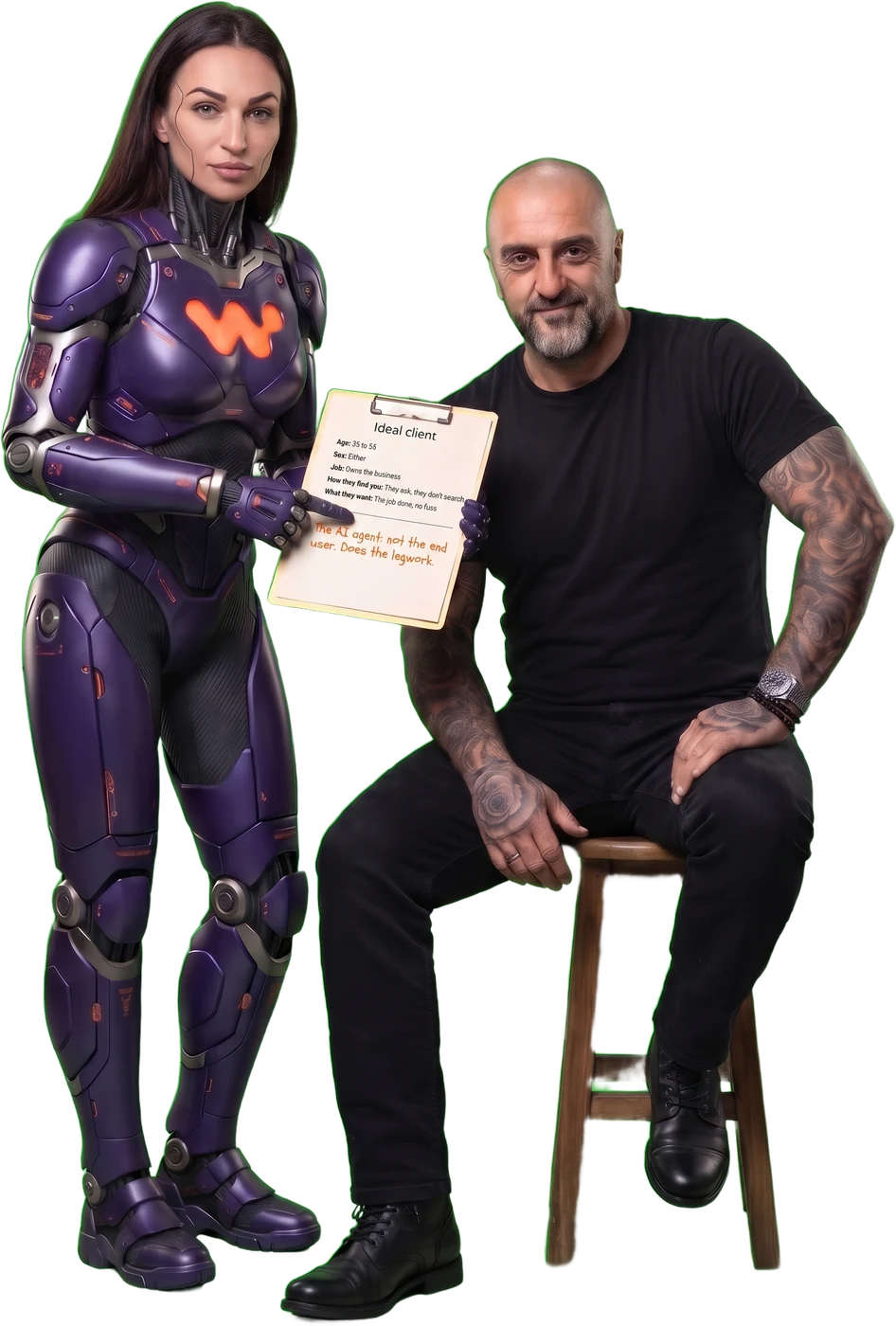
Here's where the lightbulb landed. Before, we'd sit in a marketing or strategy meeting with a client and talk about the ideal client. Age, sex, job, where they live, whatever. We've done it a hundred times. Now we add the AI agent to the ideal client sheet. And I need to be very clear here, because this is the bit people get wrong: the AI is not the end user. The human is. But it's the AI agent that's doing the leg work, and that is the attention you have to get to even get to the human. Not so much now. But it's coming.
The ideal client sheet, 2026 edition
Ideal clientStrategy meeting, page 1
- Age
- 35 to 55
- Sex
- Either
- Job
- Owns the business
- How they find you
- They ask, they don't search
- What they want
- The job done, no fuss
- The AI agent
- Not the end user. Does the legwork. Needs the correct information, easily.
The last line is the new one. The agent isn't your customer; it's the thing your customer sends ahead.
What is the B2Ai era, and how big is it?
Joe Toscano in Forbes called this the B2Ai era, business to AI, back in February, and by April Visa had a whole research programme under the same name. I love it, so credit where it's due. The numbers say it's early. Merchants in the UK and US say only 3% of their transactions involve an AI agent, but 89% of them are preparing for it. In US retail, visits sent by AI went from under 3 in every 100 in the first quarter of this year to nearly 5 in the third, and orders an agent completed itself tripled in six months, from a tiny base. The traffic that does arrive from AI converts about 60% more often than the traffic that doesn't. People will let an agent handle the boring jobs, three in four say so, but only 9% will let it go ahead and buy on its own, within limits they set. Yet. And the business side is the one that should wake people up: Gartner expects 90% of business to business buying to run through AI agents by 2028. Agents are doing our work for us more than ever, and that's the point. Who is the real demographic here?
How early is early? The B2Ai numbers, autumn 2026
Transactions with an AI agent involved
3%
89% of merchants preparing for it
US retail visits sent by AI
2.88%4.73%
Orders an agent completed itself
0.19%0.68%
AI visitors convert more often than other visitors
60%
Would let an agent handle routine tasks
74%
9% would let it buy on its own, within limits
B2B buying through AI agents by 2028
90%
Sources: Checkout.com, Agentic Commerce 2026; First Page Sage, 2 Nov 2026; Adobe via Digital Commerce 360, Aug 2026; Accenture Consumer Pulse 2026; Gartner, Oct 2025.
Is it only happening to the big names?
We're the live guinea pig again. We were talking this week about whether we even need the design subscription anymore. Small money, but money. It's cool to have everything in one place, but to be fair that's convenience. Templated work isn't what we do anymore, it's slow in a world where speed is normal, and we want the fonts and graphics where we want them, or we make our own. So the work moved to the AI tools we already pay for, and nobody in our meeting decided it. It just happened. That's Jason's story at the scale of two people in Blagoevgrad. It was right for us at the time, and it still is for millions of people. That's not the point. The point is what happens when the one doing the work isn't a person anymore.
What does an AI agent want from your business?
Ease. Simple. It needs info, and it needs the correct info. Not a pretty page, not a clever headline, not your brand story in a video it can't watch. Whilst it's more advanced than ever, we're still at junk in junk out. Give it a contradiction and it'll pass it on. Give it nothing and it'll make something up, or, worse, pick your competitor who gave it something. That's answerability, the word I used in the first of these, and it just got a second customer.
Who loses first when the agent does the work?
Who loses first when the agent does the work? Mate, all of them. The designer, the tool, the agency, the business that nobody told. And each one of those is part of the economy, so there will be ripples. Canva's 1,271 are the first ripple I can put a date on. I don't know how far they go. Patterns are what I look for, and this is a pattern, not a fact. Not so much now. But it's coming, and the agent's already in the meeting whether you've written it on the sheet or not.
The ripples, as far as I can see them
- 1,271 people at Canva told their job is changing or going, 4 November 2026
- The designer The agent builds the ad
- The tool The agent never opens it
- The agency The client's agents do the legwork
- The business nobody told The agent picks the competitor who gave it something
A pattern, not a fact. The first ripple has a date; the rest are my call.
Updates, newest first
The original call
This is the prediction as I made it that day. When something changes, I add a dated update here and leave the original as it is.