Case study · Biovaya · Bulgaria · August 2026 · Live study, updating
A supplement store Google could barely read, and AI had never heard of.
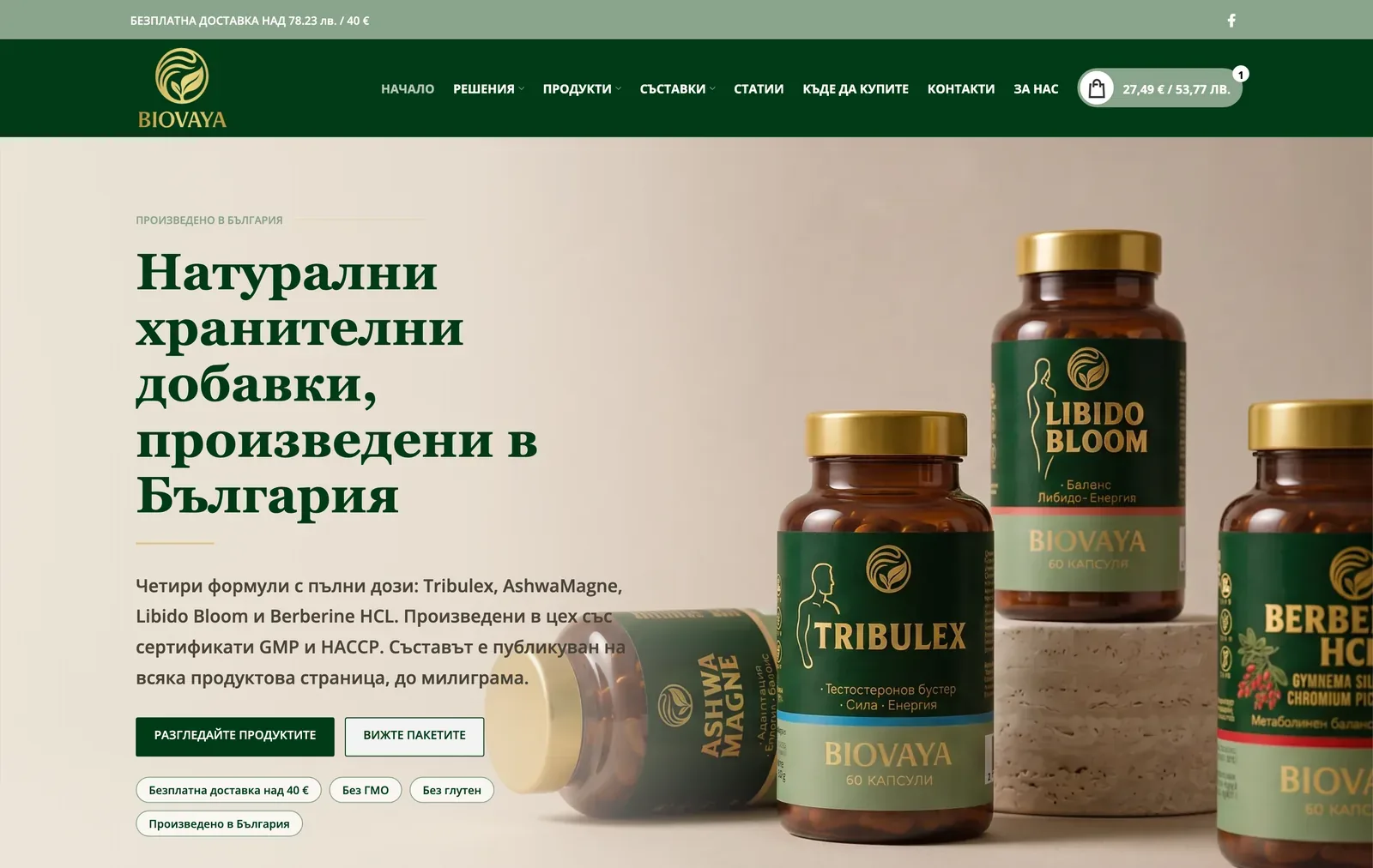
Biovaya makes four supplements in Bulgaria and sells them from a WordPress store. In August 2026 that store had no analytics, no Search Console, no Google Shopping account and almost no measurable presence in search. Meta ads were the only way anyone found it, which meant the business had one funnel and no idea what was happening inside it. Over ten days Wonder Works rebuilt the site around a single question: when a Bulgarian types a health question into Google, or asks ChatGPT the same thing, does this brand exist? This study is published early and deliberately. The work is done, the measurement is running, and we will update this page with the numbers when there are numbers worth your time.
- 24
pages built or rebuilt
- 18
articles rewritten
- 0 to 3
measurement platforms
- 10 days
start to finish, August 2026
Why did we build this for AI answers and not just Google rankings?
Because the shape of search has changed. Similarweb found Google's AI Overviews on 43% of searches in 2026, up from 15% a year earlier (TechCrunch, 27 July 2026). Google says AI Mode, which answers in conversation rather than with a list of ten blue links, passed one billion monthly users within a year of launch (Google, 19 May 2026). When Google or ChatGPT builds an answer, it does not read your page. It retrieves a passage.
That single fact rewrites how you write. A retrieval system embeds the chunk, not the page, so a sentence that says "it reduced their symptoms by nearly half" names nothing and matches nothing. Every sentence has to stand alone. Name the substance, the number, the body, the date, inside the sentence.
So every article on Biovaya now opens on a definition, carries question-shaped H2 headings with the answer in the first forty words, and cites its sources by name: the European Medicines Agency, EFSA, the French agency ANSES, the Court of Justice of the European Union, the World Health Organization, the New England Journal of Medicine. Twenty-one URLs now carry FAQ schema.
The rebuild, step by step
Almost everything a search engine reads, and nothing a customer would notice. There was no Google Analytics and no Search Console, so nobody could answer basic questions like which pages people landed on or what they searched to get there. Google Merchant Center did not exist, which meant no Shopping listings at all. Thirteen pages carried two H1 headings each because the theme printed a hidden duplicate. One FAQ schema block was broken by a single stray quotation mark, so Google was reading half of it and discarding the rest. Meta titles were missing or still in English on a Bulgarian store.
The content was thinner than the catalogue deserved. Four products, and not one page explaining what berberine is, what ashwagandha is, or why the dose on the label matters. A brand selling supplements made in Bulgaria had no page saying who made them.
Room. Search a health question in English and you compete with WebMD, Healthline and twenty years of optimised content. Search the same question in Bulgarian and Google often shows no People Also Ask box at all. When we checked four Bulgarian supplement questions on a phone on 30 September 2026, none of them had one, and all four had an AI Overview built from Bulgarian pharmacy and shop blogs.
That absence is the opportunity. Question-shaped headings with a straight answer underneath, written properly in Bulgarian, cost almost nothing to get right, and they give Google and the AI assistants exactly the kind of passage they are looking for. The same is true of the AI answer engines: they are answering Bulgarian health questions today from whatever Bulgarian-language source they can find, and the supply is thin.
We wrote for the words Bulgarians actually type.
Twenty-four pages and eighteen articles. An encyclopedia of twelve ingredient pages, each one covering a single substance: what it is, where it comes from, the dose, who should avoid it. Four solution pages and a hub, built around the problems people search for rather than the products we sell. A new homepage, an about page carrying the founder's real story, and a where-to-buy page. All four product pages rebuilt.
Underneath that: Google Analytics 4 and Search Console connected and verified, Merchant Center set up and the feed submitted, an XML sitemap filed with indexing requested, and robots.txt opened to the AI crawlers that matter, GPTBot, ClaudeBot, PerplexityBot and OAI-SearchBot. Blocking those is a common accident and it makes a brand invisible to exactly the systems now answering questions on its behalf.
We also automated the review flow through Klaviyo, two emails per order, and ran it back across the existing customer base. Reviews are not decoration. Genuine, dated, first-party reviews are one of the few signals that separates a real brand from a drop-shipper, and both Google and the answer engines can tell.
Honestly, WordPress is not our stack. We build on modern frameworks and we would not have chosen WooCommerce, Woodmart and 25 plugins for this brand. But Biovaya was already there, with a live catalogue and an order history, and a platform migration would have cost the client months it did not have. So we kept the platform and changed the way we work on it.
Every change went through the site's own REST API, the direct route into a WordPress site's content, rather than through the admin panel. That sounds like a technical footnote. It is the reason twenty-four pages and eighteen articles moved in ten days without a single broken URL.
The method is what matters. Each change is specified precisely, applied through that API, then read back from the live site and compared against what was sent. After we rescaled the logo, we checked every one of 234 images and 72 internal links on the affected pages before calling it finished. When we replaced the product cards inside fifteen articles, we confirmed all fifteen matched byte for byte after saving.
The judgement behind every change is ours: which claims are lawful, which pages deserve to rank, and what a Bulgarian buyer actually searches for at eleven at night.
Because it was illegal, and because deleting it made the site more visible, not less.
Food supplements in the EU may only carry health claims from an authorised list. Biovaya's pages were full of the kind of sentences that are common on supplement sites and almost never allowed. Google Shopping had already noticed and rejected most of the catalogue.
So we went to the source, pulled the authorised claims from the Bulgarian text of Regulation 432/2012 word for word, and rebuilt every product statement on top of them. It turns out the law lets you say the commercially valuable thing, as long as you credit the right ingredient. Zinc contributes to the maintenance of normal testosterone levels in the blood. That sentence is authorised, checkable and it belongs to the mineral, not the plant.
Then the useful part. A page that says "clinically proven" and cites nothing is invisible to an answer engine. A page that names a regulation, quotes a 2024 committee decision and links the primary source is exactly what a citation looks like. Compliance and AI visibility turned out to be the same job.
This is why the analytics went in first. From here the site stops being rebuilt on judgement and starts being tuned on evidence.
Search Console tells us which Bulgarian queries the new pages are appearing for and where they sit, so we refresh the pages that are close rather than writing new ones nobody asked for. Its generative AI report, which Google rolled out to every website on 31 August 2026, shows impressions inside AI Overviews and AI Mode.
Analytics 4 needed one custom job. Its built-in AI channel misses referrer-less traffic, so we group ChatGPT, Perplexity, Claude, Gemini and Copilot into their own channel and report conversions rather than sessions, because AI referrals arrive further down the decision than search traffic does.
On top of that, a monthly run of tracked prompts in both Bulgarian and English, asking the assistants the questions a customer would, and logging whether Biovaya appears and which page gets cited.
Then we act on it. That is the whole point of the ten days.
Inside the rebuild
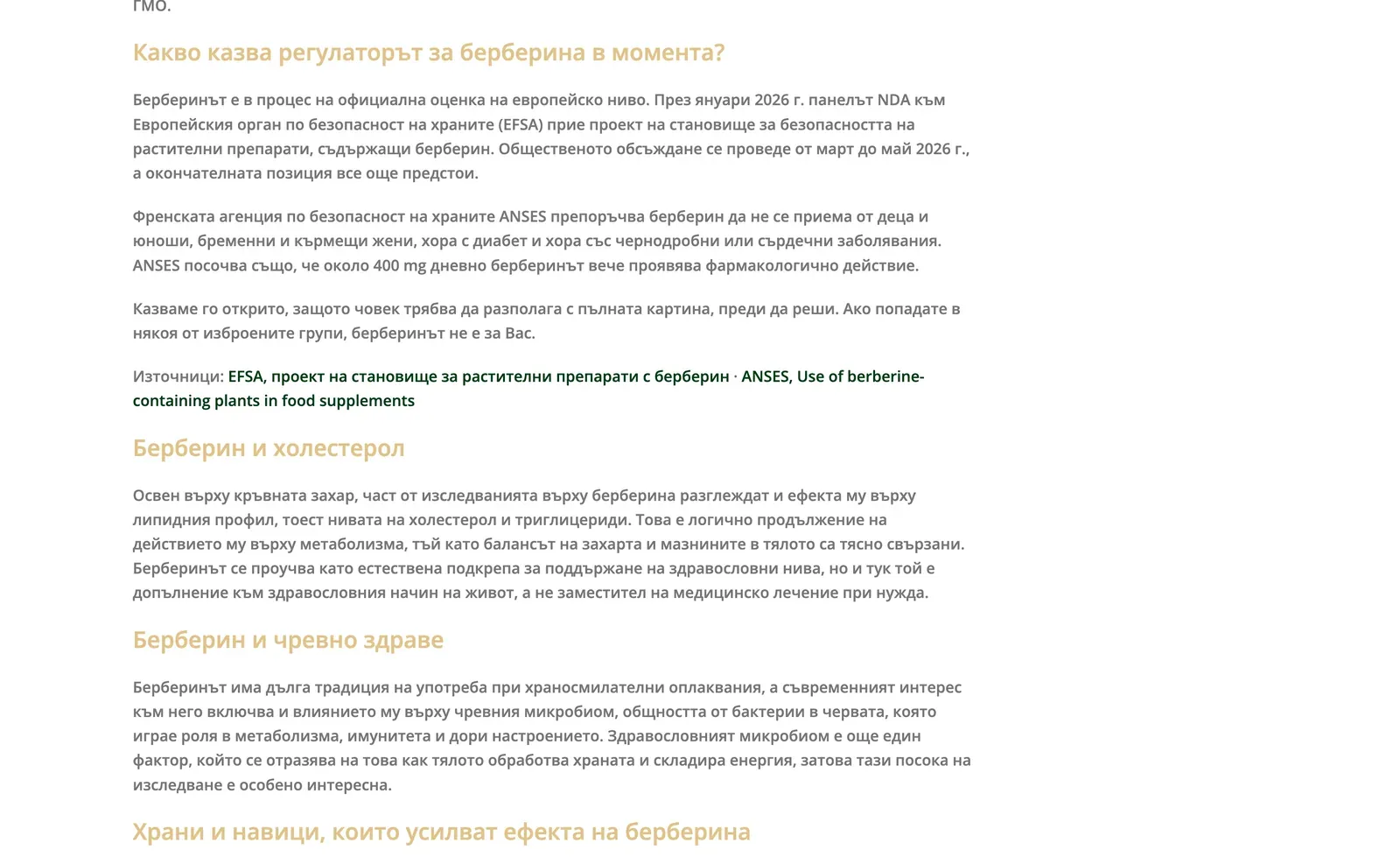
A rewritten Biovaya article, with EFSA and ANSES named and linked as sources at the end of the section. 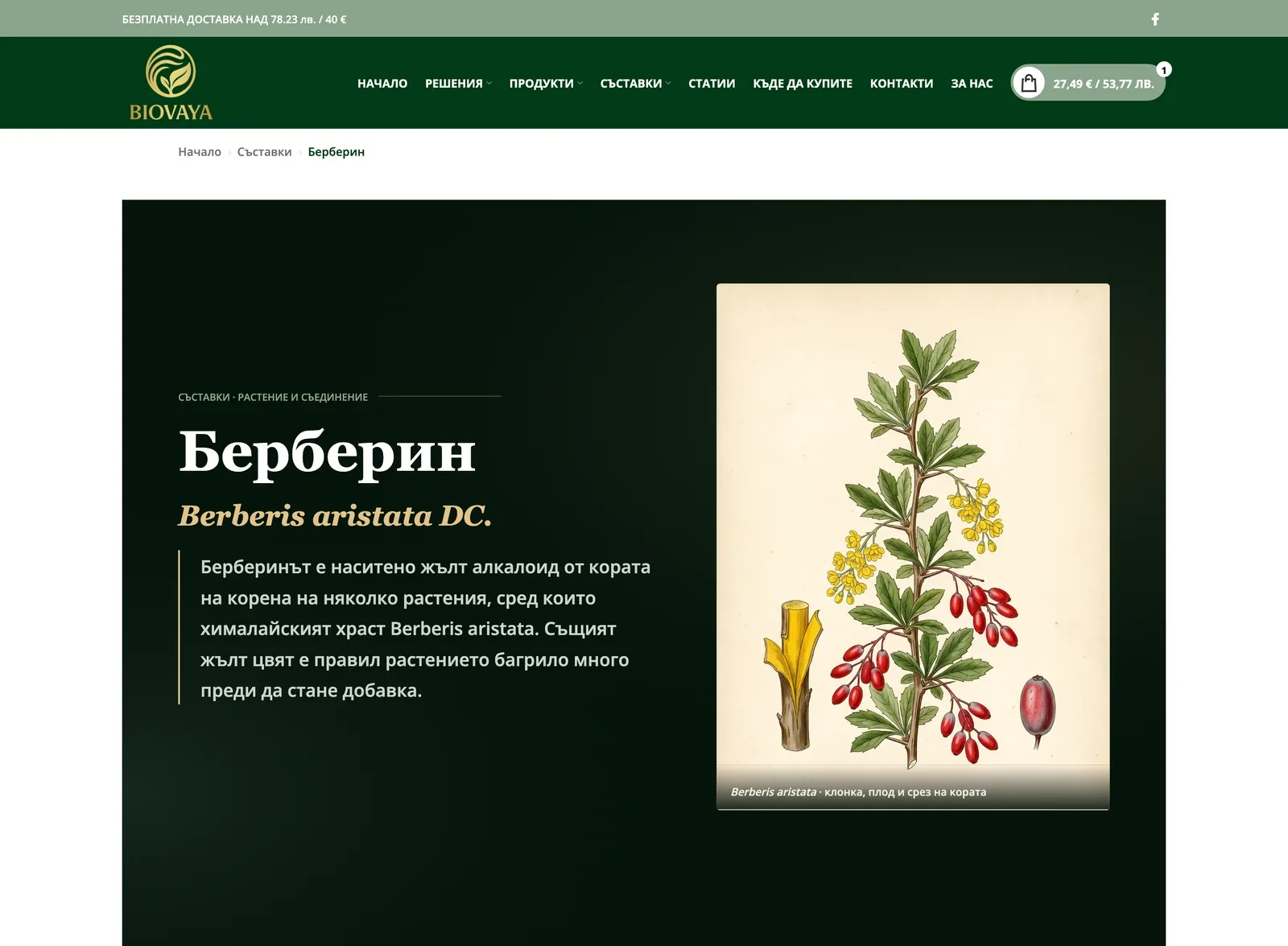
A Biovaya ingredient encyclopedia page for berberine, showing the botanical name and a plate illustration. 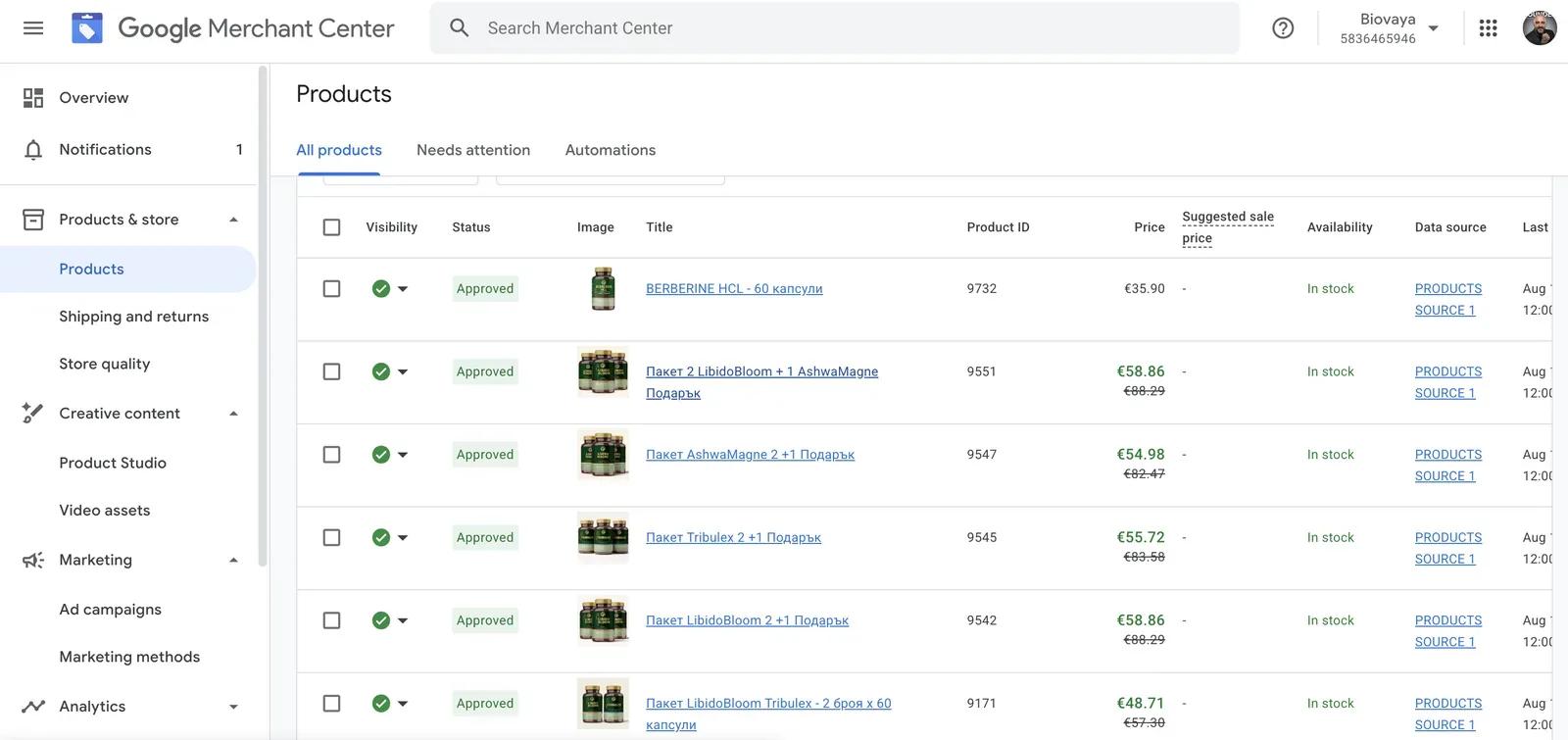
Google Merchant Center showing every Biovaya product approved after the product copy was rebuilt on authorised health claims. 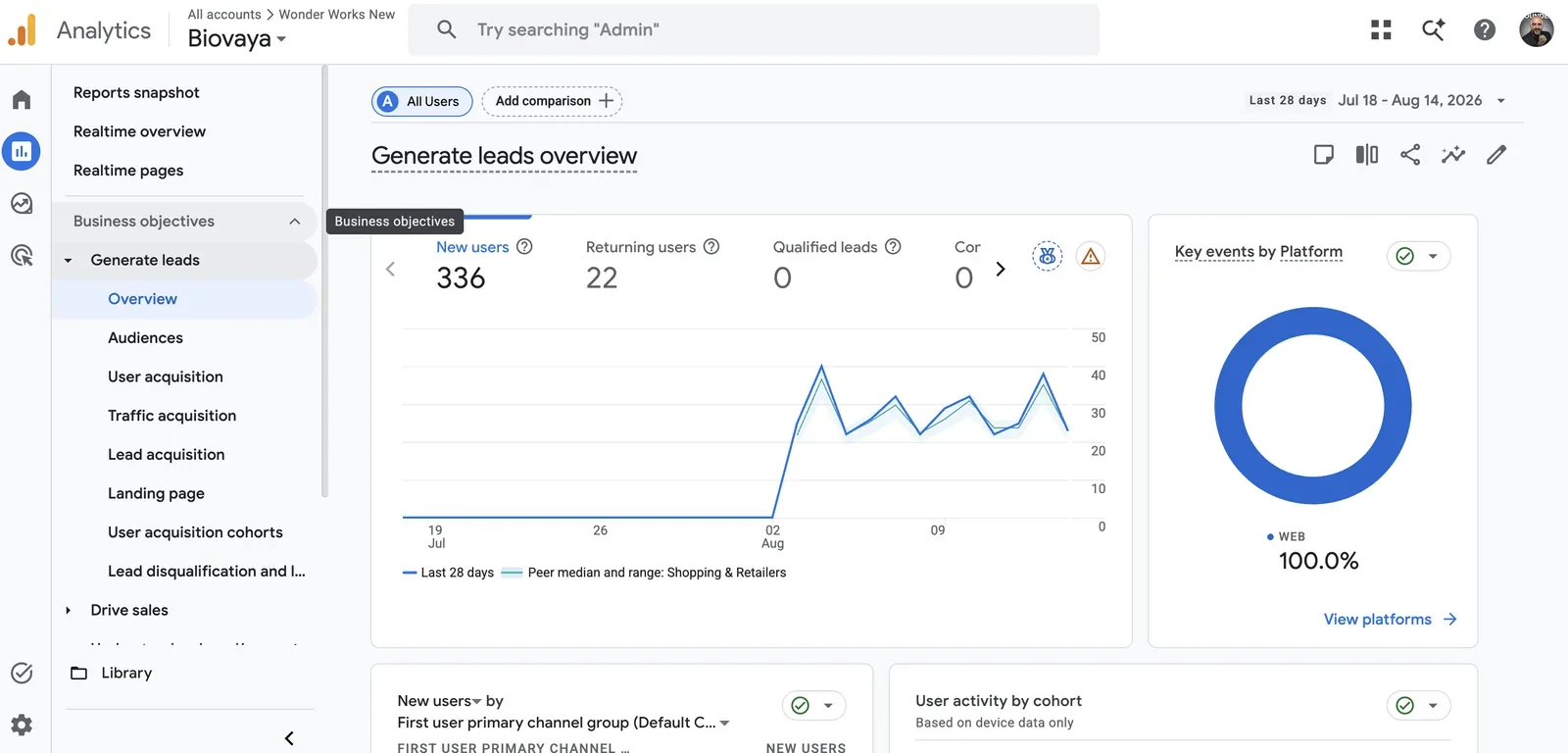
Google Search Console for biovaya.eu seven days after the rebuild, showing the first impressions and clicks arriving.
Here is the part that's easy to miss. AI assistants cite what they can check. A page claiming "clinically proven" cites nothing, so nothing cites it back.
What actually moves AI visibility?
Self-contained sentences
Answer engines retrieve passages, not pages. A sentence that leans on the paragraph above it cannot be quoted. Name the substance, the number and the source inside the sentence.
Primary sources, cited by name
"Studies show" is worth nothing. "The EMA committee concluded on 20 November 2024" is worth being quoted. Assistants cite what they can verify.
Questions as headings
People ask questions and assistants answer them. A heading phrased as the question, with the answer in the first forty words underneath, is one of the cheapest structural changes a site can make.
Say the uncomfortable thing
Pages that state limits, name what is not proven and admit what is unknown give an assistant something it can check and repeat safely, which a page that only sells never does. Honesty is a retrieval strategy as well as an ethic.
This is what our approach to SEO and AI search looks like when it starts from a site nobody could measure. Our Marketing partnership covers the rest.
What nearly caught us out, and what comes next
We got a piece of the regulatory reasoning wrong and had to redo five pages six days after building them.
Roughly 1,500 health claims for botanical ingredients sit unassessed in EU limbo, neither approved nor rejected (EFSA counted 1,548 put on hold). We had treated that gap as room to speak carefully, which is a common reading of it. Then we read the Court of Justice ruling in case C-386/23 properly. It closed the gap in April 2025: while the assessment is unfinished, botanical claims touching psychological or behavioural function are not permitted at all.
So we rewrote the four solution pages and the hub. Nobody made us. No client complained, no regulator wrote, and the pages had already been signed off. We found it in our own work and fixed it inside a week.
The search numbers are still coming in, and they go on this page three months after the rebuild, in November 2026. Meanwhile Biovaya's Facebook page was seen 235,684 times by 116,044 viewers between 1 August and 30 September 2026, with 134,178 of those views organic and 101,496 from ads.
Questions
Why is there no search results number in the Biovaya case study yet?
+
Because the numbers that matter in search take months to arrive. Wonder Works rebuilt Biovaya's site in ten days in August 2026, and Search Console started reporting within the first week, which is why you can see it above, but a few weeks of early impressions is not proof of anything, and a headline number published now would be noise dressed as proof. The measurement is running and this page gets updated three months after the rebuild, in November 2026. We would rather publish early and honestly than wait and then round up.
Does Wonder Works work on WordPress?
+
Not by choice. We build on modern frameworks, and for a new project we would not pick WordPress. When a client is already on it with a live catalogue and years of orders, as Biovaya was, migrating costs more than it returns, so we work on the platform they have and bring our own method to it.
What is AI SEO, and is it different from normal SEO?
+
AI SEO overlaps with normal SEO, but it is not the same. Classic SEO gets you ranked in a list of links. AI search decides whether an assistant quotes you inside an answer, which depends on whether your sentences can be lifted out and verified on their own. Both matter. We build for both, and measure them separately, because a page can win one and lose the other.
The Biovaya rebuild took ten days. What is the catch?
+
The catch is that those ten days of execution sat on top of research, and that Biovaya already had good products, real manufacturing and a founder with a genuine story. Speed comes from the method and from not having to invent the substance. A brand without those still needs the slow part first.
Is the Biovaya website finished?
+
No, and it should not be. The build is done and the measurement has started. Content gets refreshed against what Search Console shows, AI visibility gets checked monthly, and the technical work continues. A website that is finished is a website that is decaying.
Want to be found when the answer is written for you?
Biovaya runs on our full Marketing plan: SEO, AI search, content, compliance and the technical work underneath. If you sell something people search for and you are relying on paid ads to be found, that is the conversation to have.
Can AI read your website?
Marketing, €1,500 a month at mostAsk us anything.All case studies